Showing posts with label Pull and Peel. Show all posts

Sunday, February 23, 2014

Low Winter Sun

Speed Graphic Grafex Optar 135 f4.7 FujiFilm FP-100c - The sky was an amazing blue this afternoon and I took the chance to break out the Speed Graphic and shoot some Fujifilm FP-100c.
Scanned with a HP Scanjet G4050 using HP's OEM software.

Monday, November 4, 2013

Instant Autumn

Speed Graphic Grafex Optar 135 f4.7 FujiFilm FP-100c - Autumn is my favorite season, the crisp cool air, the color and the world just seems to smell cleaner... Shooting up through the changing leaves of a mammoth Black Walnut Tree, a single cloud floating by in the clear blue sky. Perfect.
Scanned with a HP Scanjet G4050 using HP's OEM software.

Monday, March 25, 2013

Instant - Snow

Polaroid Automatic 100 Fujifilm FP-3000B - Sunday was a snowy day in Lynchburg Virginia and this was the view from my office window. The first real test of my modified Polaroid Auto 100, an it worked perfectly. I was surprise how will this old cameras metering system handled the high Contrast scene, especially given that the ISO of this film is 3000!
Scanned using a HP Scanjet G4050 and HP's OEM Software


Saturday, March 16, 2013

Polaroid Automatic 100 4.5v Battery Modification
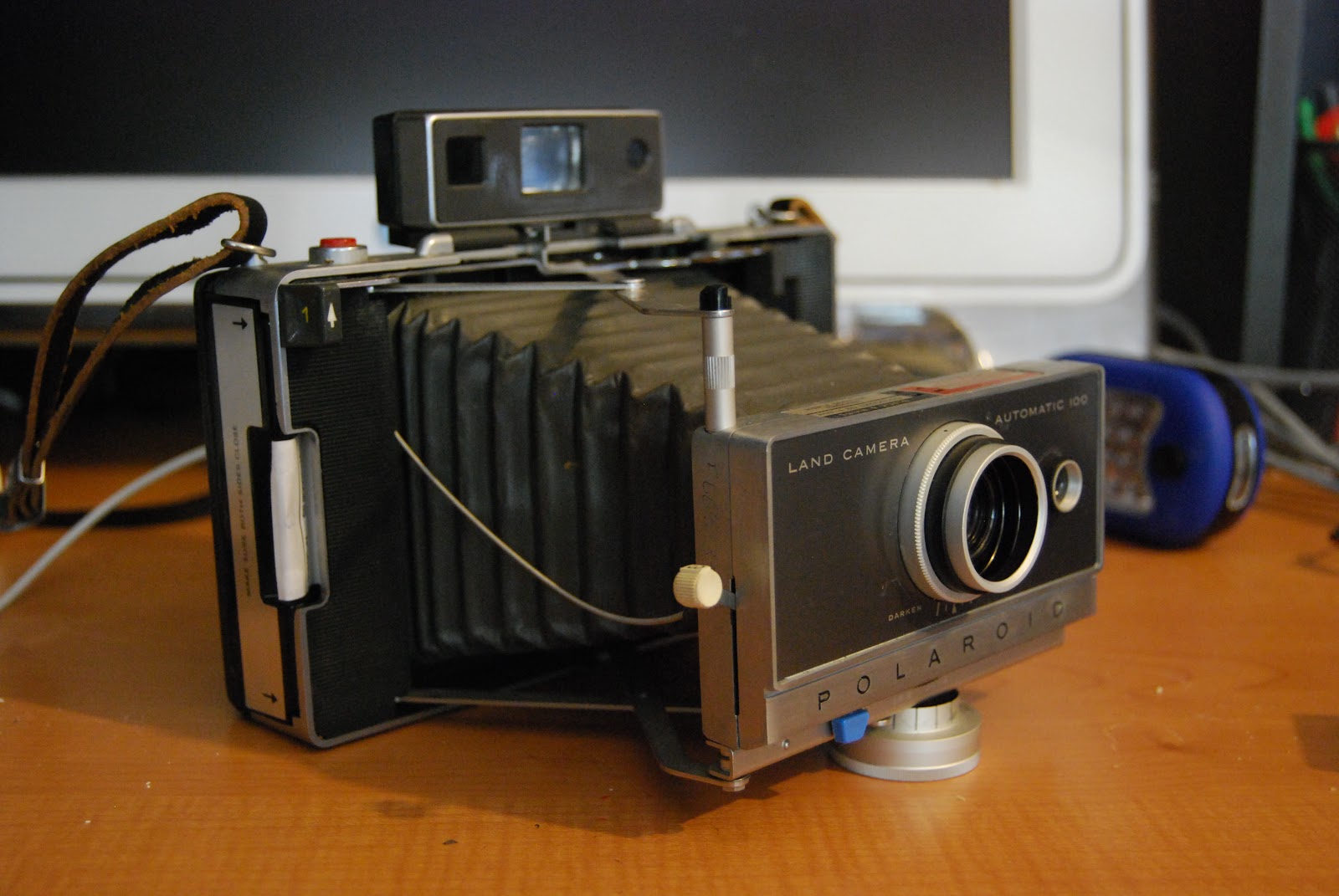

The Polaroid Automatic 100 - This was my first instant camera. Actually this is the very camera used to take many of my baby pictures as it came into my family about the same time I did. To me, this is the classic Polaroid Pull and Peel pack film camera. Film is still readily available to these cameras in the form of Fujifilm FP-100c Color and FP-3000b Black and White. The original Polaroid Type 108 Color Film used in this camera was ISO 75 so you do have to make a minor adjustment for the slight faster Fujifilm FP-100c ISO 100 film.

Image source www.dianacamera.com Kai Yamada
The Achilles Heal of these cameras always seems to be the odd Eveready No. 531 4.5v battery that powered the automatic shutter. Generally only available from camera stores, the 531 was slightly larger than a AA battery and had 9v battery type connectors on each end. These batteries had a nasty habit of leaking when left in the camera too long, damaging the cameras internal connectors. Though still available the No. 531 is increasingly hard to find and expensive, so finding a more readily available and less expensive alternative is a must for those of us that want to continue using these cameras. The most common alternative is replacing the No. 531 with an external 3 AA or AAA Battery Holder. I chose the Radioshack Model #270-412 3 AAA 4.5v holder.


The conversion is relatively straight forward, simply a matter of removing the old 9v type connectors from the battery leads in the battery compartment of the camera and soldering the leads from the new battery holder to the leads of the camera. You can find detailed instructions at Instant Options, as well as a videos of the process on YouTube here and here. The battery holders demonstrated vary, but these are good starting points. To the left you can see my completed conversion with the battery holder mounted outside of the camera with velcro.


The biggest annoyance in the process is the fine gauge of the internal camera lead wires and the lack of slack for trimming and stripping the insulation. Any mistakes and the leads get short fast, so be careful and try to get the right the first time. Also if you do mount the battery holder on the back of the camera, remember to mount it a low as possible, mounting it to high can make focusing and viewing awkward. Do no mount it too far to the left as it will interfere with your ability to hold the camera firmly enough to pull the film after exposure.

The battery compartment door must also be notched to allow for proper routing of the new battery leads outside of the old battery compartment. The battery compartment door is thin aluminum and is easy to cut with a strong razor blade or wire snipes. The edges are sharp, I would suggest using a grommet or electrical tape to protect the wires from damage.

Mission accomplished, a new life for an old camera.


Polaroid Automatic 100 Specification

Lens: 114mm f/8.8 3-element glass
Shutter: Electronic; 10 seconds - 1/1200
Separate window view/rangefinder assembly (has a hinged base-- flips up for use and is held in place with a magnetic catch-- folds down for storage and fits inside the camera's plastic cover)
Viewfinder: Projected framelines and automatic parallax compensation.
Exposure Control: Aperture-priority automatic only
Film speeds: 75, 150, 300, and 3000 ASA.
Exposure compensation: Dial with range of -1/+2 stops 
Construction: Metal Body and metal shutter/lens housing; has tripod socket


Wednesday, November 7, 2012

Wilted Passions (Instant Love)

Calumet Cambo View Camera Schneinder-Kreuznach Symmar 210mm f5.6 FujiFilm FP-100C Instant Pack Film - I do not believe our strongest passions ever die. They may wilt, dormant, but they are always there. We may never choose to breathe life back into our passions. Ignored they shrivel, simply awaiting the warmth of our attention to be revived. For me, Photography was one of those wilted passions. A love that the became a career, and the career displaced the love. The love is back.

I am finding my way with large format photography. 35mm and Medium Format had always been my weapons of choice. The tedious nature of view cameras did not appeal to me in my unfocused youth. I guess  have calmed, if only a little.

Saturday, September 29, 2012

Hampton Hobby House Polaroid 665 Circa 1985

Polaroid Automatic 100 Polaroid 665 Positive/Negative Film - I was rummaging through my photo drawer and ran across this gem. Yes that is me circa 1985, manning the photo counter at the Hampton Hobby House in Hampton VA.. My first real job and the best job a budding photographer could ever have. I would kill to have access to half the photographic artifacts that were hidden in the drawers and boxes of that wonderful store. This was taken by my co-worker and partner in crime Alan Hilliard. We were playing with an outdated pack of Polaroid Type 665 Positive/Negative film. The print of this image was lost long ago, but I tucked away the washed negative in a plain envelope for safe keeping. Ah, the memories, some of the best days of my life. Polaroid recommended fixing the negatives with a sodium sulfite solution if I remember correctly, but we just washed them in water to remove the black backing. The negative held up pretty well over almost 30 years.